Principal Investigator, Zetesis Labs ·
Principal Scientist, Noumenal AI ·
Senior Researcher, ARTPARK @ IISc
Bengaluru, India
Building verified, long-horizon synthetic discovery:
measurement, causal world-models, and a formal verification platform
composed into systems that stay correct as conditions change.
I want to change the world to match an image in my mind, a world where
discovery is faster, more reliable, and less hostage to luck.
Bengaluru, 2026
01 · Engineered discovery
Inquiry is treated as a controllable operator. Unknowns are typed,
explicit, testable.
02 · Measurement before models
Trustworthy traces are the substrate of trustworthy inference. Most
"AI failures" are calibration failures in disguise.
03 · Verification at stake
Systems must audit their own uncertainty. The output surface is tethered
to evidence, not narrative fluency.
Education & Awards
Education, awards, invited talks, teaching, and references.
Full CV (PDF).
Education
B.S. (Research), Biology, Indian Institute of Science, Bangalore
(2021–2025). First Class with Distinction, CGPA 8.8/10.
Top-ranked thesis (A+): Measuring What Models Miss.
Lab training
S. P. Arun (visual neuroscience, IISc) ·
clinical neurology internships, Sir Ganga Ram Hospital, Delhi (2022, 2023) ·
MSOT neuro-endocrine imaging under Prof. Sanhita Sinharay, IISc (2023) ·
neuro-optics under Alistair Lewis (postdoc), Arjun Yodh lab, U Penn (2022, hybrid).
Awards
iGEM 2022 Gold Medal (Paris Jamboree), Best Climate-Crisis
nomination ·
KVPY Fellow (AIR 50) ·
JEE Main 99.94th percentile ·
Abhiprajna (AIR 1) ·
All-India Subject Topper (Biology) ·
CBSE X & XII 98.7% / 97.6% (100% in Math, Science, Computer Science).
A Textbook of Formal Learning Theory ·
self-authored open-access monograph (202 pp, 18 chapters, 142-node concept
graph).
PDF
·
source.
Neuromorphic Computing at IISc IEEE (120 participants, 3 days,
March 2024); Neural Networks → Circuits → DNA at the
All-India iGEM Meet (60 participants, 16 institutions, July 2024);
GNNs for Breast-Cancer Drug Discovery at IIT Delhi (35 h, 26
M.Tech./PhD, October 2024); embedded C / RTOS / Cortex-M crash course via
IISc Robotics Club (Jan–May 2023);
The Mathematics of
Change, a 6-hour workshop at a college fest
qualifier, organised by EduTech (50+ participants, experts included),
on climate as a control system with epistemic limits.
Magnetic Fields in the
Heavens, a problem set written for a national physics
competition organised at IISc, walking students from coffee-pot convection
to stellar dynamos (open challenge: tackle it, and if you get it right we'll
be very good friends).
Industrial leadership
Innovator-in-Residence and Board Member, ARTPARK Industry 5.0 programme
(2025–2026).
References
Prof. Bharadwaj Amrutur, Dept. of Electrical Communication
Engineering, IISc Bangalore (career mentor; sponsor of JRD-Tata ISC, ARCNet, IiR
charter) ·
Prof. Sumanta Bagchi, Centre for Ecological Sciences, IISc
(undergraduate thesis advisor, Terrapulse) ·
Prof. S. P. Arun, Centre for Neuroscience, IISc (TCN instructor,
neuroscience collaborator) ·
Prof. Dipankar Nandi, Dept. of Biochemistry, IISc Bangalore
(Essentials in Immunology course instructor; course-based recommender) ·
Dr. Ishaan Gupta, PI, Fungel Lab (Functional Genomics),
Dept. of Biochemical Engineering and Biotechnology, IIT Delhi ·
Gopika Kannan, ex-VP Cognitive Solutions & Innovation,
MassMutual ·
Vish Ranganathan, Gigafactory & Autonomous Robotics /
Physical AI Leader, Panasonic Energy of North America ·
Narayan Rangarajan, Head of Agile R&D, Ather Energy ·
Dr. Sudip Mondal, Head of Hardware, Firmware, and Systems
Engineering, Ather Energy.
Ayush Mittal · Dhruv Gupta ·
arXiv:2606.11417 · June 2026 ·
cs.LG / stat.ML · 16 pages · Lean 4
mechanization of the structural core.
An intrinsic-reward signal paid only for learning, with a
certificate. If reward is the signed decrease of a fixed
sealed-audit loss, cumulative reward equals endpoint audit
improvement exactly. No policy can push reward up while true audit
performance stagnates.
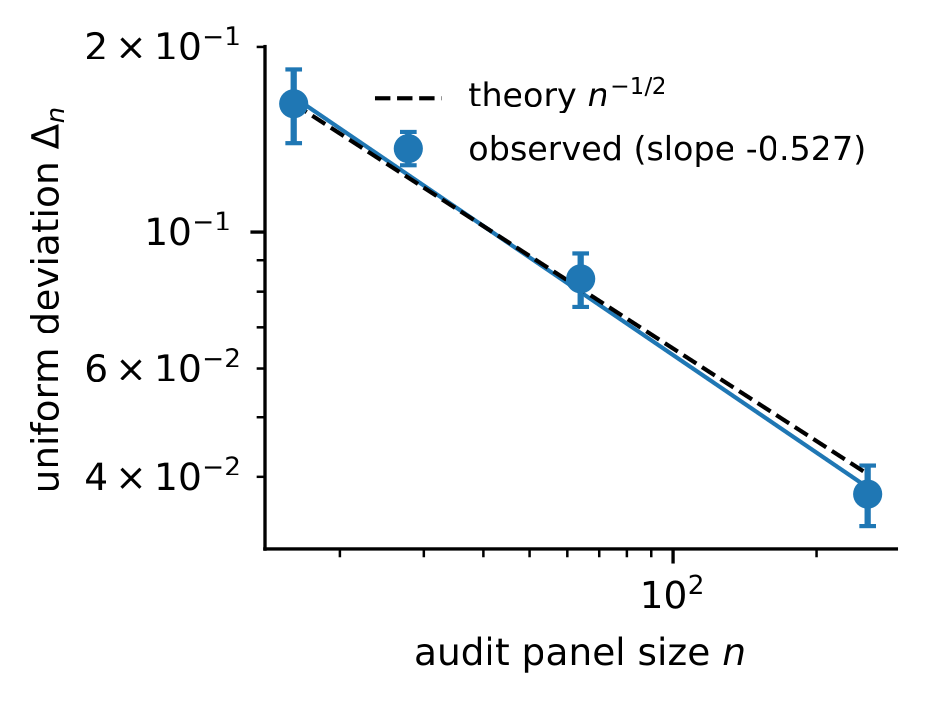
Figure 3 (witnesses both theorems).
Δn decays with audit panel size
n at slope −0.527, matching the theoretical
n−1/2 rate (ARC-TGI, 20 seeds).
The 2Δn budget in Theorem 2
is therefore empirically small and monotonically shrinking;
in the limit it collapses to Theorem 1's exact
zero-budget case.
Dhruv Gupta · Lean4 cslib · PR #592,
merged 29 May 2026 by Samuel Schlesinger · 350 lines, new file
Cslib/MachineLearning/PACLearning/VersionSpace.lean ·
Apache 2.0.
First merged upstream contribution to Lean4 cslib. The version space
is the classical “concepts still consistent with the data” object of
Mitchell (1977) and Angluin (1980); the contribution adds it to cslib's
PAC-learning library as the foundation for downstream Sauer–Shelah, PAC
lower bounds, and infinite no-free-lunch results. Includes structural
properties (subset of the original class, equality on the empty sample,
monotonicity in the class, antitonicity in the sample); a combinatorial bridge
(mem_versionSpace_iff_empiricalMiscount_zero) and a
measure-theoretic bridge
(mem_versionSpace_iff_empiricalError_zero) connecting the
abstraction to the empirical Dirac mixture used by PAC learning; and
realizable-case results (non-emptiness, and almost-sure target containment
under iid sampling from a realizable joint distribution). Validates that
portions of the FLT kernel meet the upstream quality bar cslib maintainers
enforce on merges.
The abstraction and its headline structural
theorem, from the merged file
(Cslib/MachineLearning/PACLearning/VersionSpace.lean):
/-- The *version space* of a concept class `C` given a labeled sample `S`:
the set of concepts in `C` whose labels agree with `S` on every observed point. -/defVersionSpace {m : ℕ} (C : ConceptClassαβ) (S : LabeledSampleαβm) :
ConceptClassαβ :=
{h∈C | ∀i : Finm, h (Si).1 = (Si).2}
/-- *Version space antitonicity.* Given a sample of size `n` and `m ≤ n`, the
version space on all `n` observations is a subset of the version space on the
first `m` observations. -/theoremversionSpace_antitone {mn : ℕ} (hmn : m≤n) (C : ConceptClassαβ)
(S : LabeledSampleαβn) :
VersionSpaceCS⊆VersionSpaceC (S∘Fin.castLEhmn) :=
versionSpace_reindex (Fin.castLEhmn) CS
More data refines the version space: the version space
on a larger sample is contained in the version space on any prefix. The proof
is a one-liner via the reindexing lemma.
Dhruv Gupta · Zenodo (v1),
DOI 10.5281/zenodo.20147210 · May 2026 ·
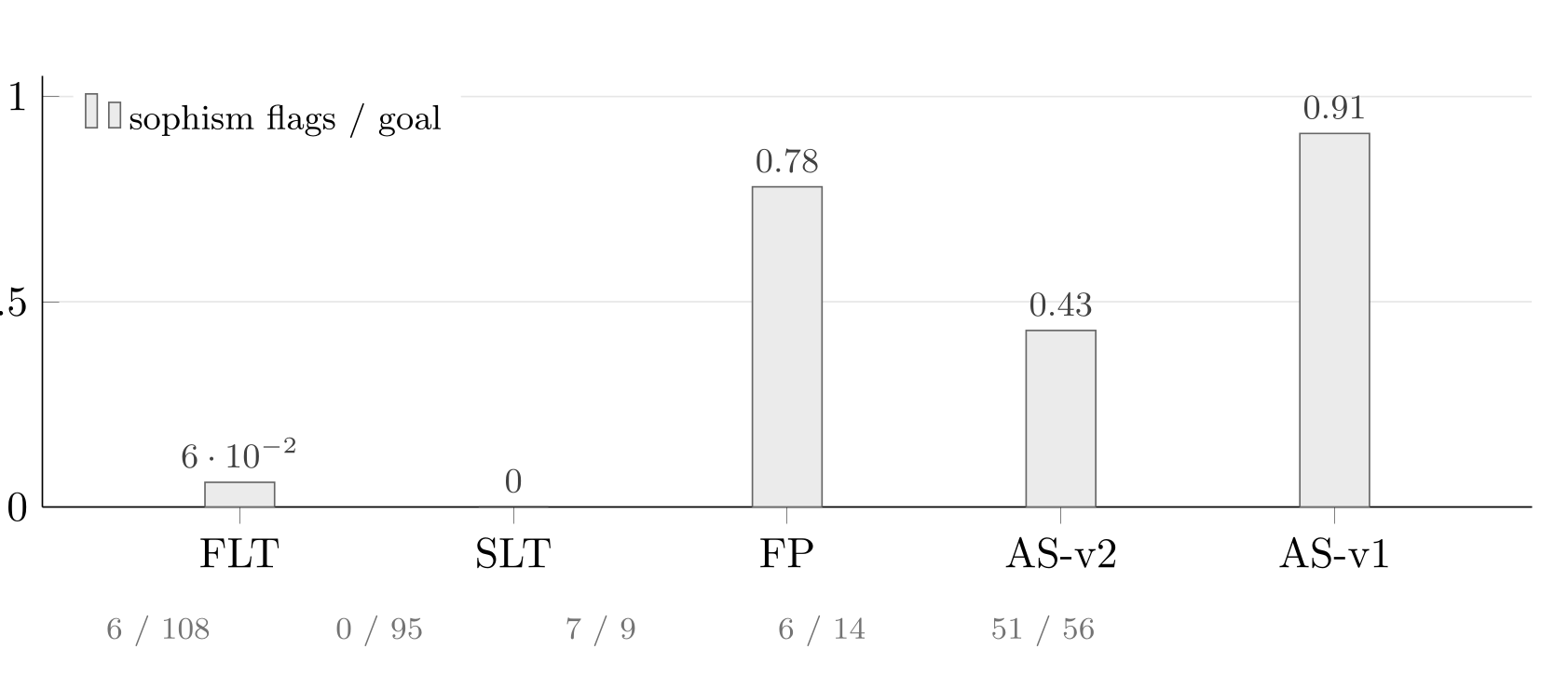
five substrates (FLT, SLT, FirstProof, AI Scientist v1,
AI Scientist v2) · 620 evaluated units, 282
schema-valid goal records.
A backward audit instrument for completed LLM-driven research
artifacts. Four invariant predicates (plausibility, coherence,
completeness, invariance) over two object-types (the
goal and the witness) give a 25-cell
process-evidence vocabulary that endpoint accept/reject metrics
cannot resolve.
The Borel-measurability hypothesis Krapp–Wirth 2024 places on
the symmetrization step is unnecessarily strong. A continuous
parameterization of an analytic non-Borel set yields a concept
class whose bad event is null-measurable but not Borel; the
construction is non-pathological because the same
projection-through-argmax step is what attention does at every
depth of a true transformer.
Where the witness's bad event sits in
descriptive-set-theory:
Analytic (Suslin
closure; null-measurable by Luzin)Borel (KW 2024
assumes)← bad event B
B = projection of a
Borel-parameterized class through
g: β → ℝ.Strict separation:
Borel ⫋ Analytic,
so the witness escapes KW while Luzin keeps
it PAC-learnable.
Same construction at depth L
of a true transformer (TLT
depthTemperatureCliff):
softmax routing
(τ < ∞): Borel at every depth
L1
L2
…
LL
↓ τ→∞↓↓↓
L1
L2
…
LL
argmax routing
(τ = ∞): non-Borel at every
depth
Temperature is the toggle; the
cliff fires at every layer.Same tree object, same parameter
space — the bad event drops from Borel to analytic
uniformly in L.
Dhruv Gupta · B.S. (Research) Biology Thesis,
Department of Biology, IISc Bangalore · April 2025 ·
top-ranked, A+ · Supervisor: Prof. Sumanta Bagchi
(Centre for Ecological Sciences) ·
Zenodo, DOI 10.5281/zenodo.15391354.
Soil microbial CO2 dynamics happen on sub-minute
timescales: Birch-effect rewetting pulses, microbial dormancy
transitions, enzyme-saturation bursts. Soils hold 1,500 Pg C
(twice the atmosphere) and respire 90–100 Pg C yr−1;
anthropogenic emissions are 10 Pg C yr−1.
Aggregating CO2 flux to weekly or monthly means
erases the microbial signal, so the largest natural carbon flux
on the planet is also the least biologically observed. Until
the biological drivers of respiration and carbon turnover are
directly observed at the scales and resolutions they operate on,
climate models will remain free to disagree without
contradiction.
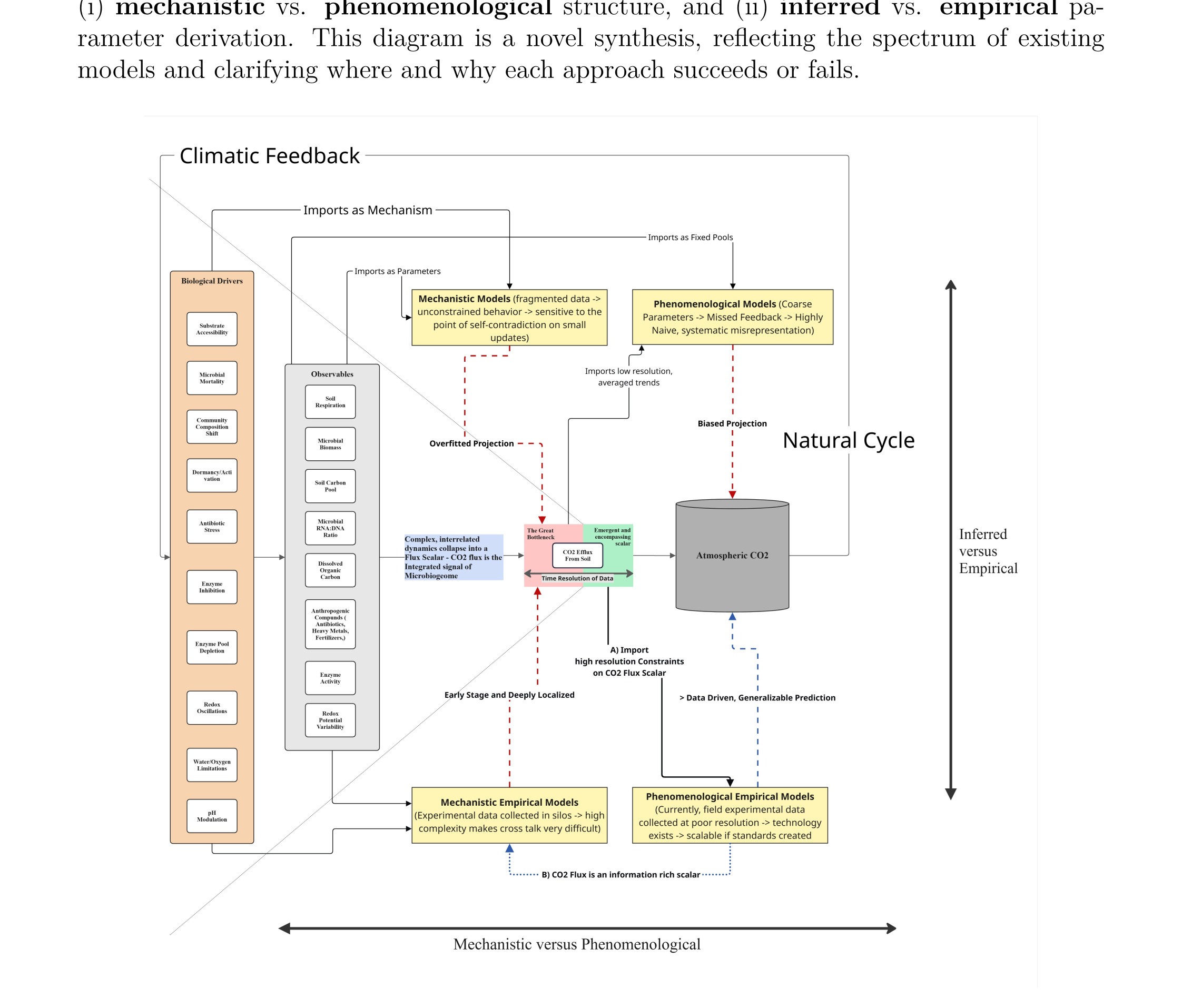
Thesis Figure 1: Quadrant Diagram of
Soil Carbon Modeling (original contribution).Biological drivers (substrate
accessibility, microbial diversity, enzyme limitation,
redox oscillations, …) sit at the LEFT,
untouched by most modelling cells.Each quadrant has a distinct
failure mode; the missing axis is empirical–mechanistic
high-resolution constraints on the CO2 flux
scalar (arrow A).
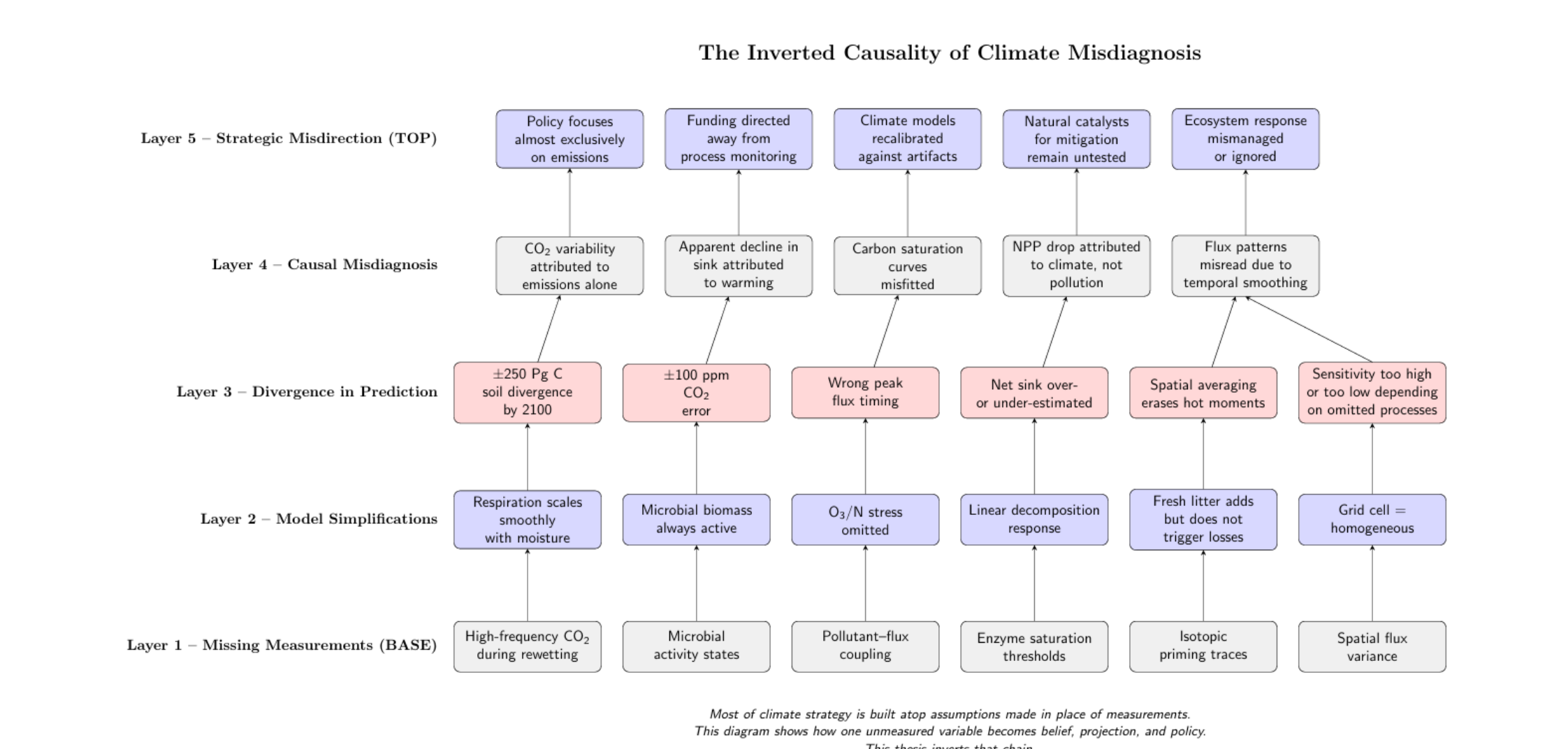
Thesis Figure 2: Inverted Causality
of Climate Misdiagnosis.One unmeasured biological variable at
the base becomes belief, projection, and policy at the
top.Base cells include high-frequency
CO2 during rewetting (Birch effect), microbial
activity states, pollutant–flux coupling, enzyme
saturation thresholds, isotopic priming traces, spatial
flux variance.
Personal and Zetesis research code, live from
@Zetetic-Dhruv.
ARCNet client deployments (Satsure, School of Meaningful Experiences, Open Science
Stack) are listed with their clients in
Studying Discovery While Doing It.
Loading profile data from GitHub…
Repositories
Loading repositories…
Contribution Activity (last year)
Loading contribution graphs…
Public GitHub REST API · cached locally for 30 minutes · contribution graphs
rendered via ghchart.rshah.org.
The Programme (2025–Present)
At Zetesis Labs I run one research programme asking whether discovery can be engineered
rather than left to chance. Current work separates into three layers, each with concrete
artifacts: a verification platform written in Lean4; a
synthetic-discovery stack (LLM harness → compile-filter
pipelines → verified outputs); and industrial and biomedical pilots
that test each piece against reality. The programme's deployed outputs are Layer-2
(root-cause analysis, calibration, compliance, reliability planning), not philosophy as
user interface.
What ties this together is a long-running interest in discovery itself, both as it
happens socially in groups and as it can be made to happen in artificial systems.
Each role I have taken on, whether by chance or by intuitive design, has let me probe
that question at a larger scale than the last.
What follows is what each layer looks like as a working instance.
Selected Work
Active pilots and released artifacts, organised by layer.
Projects tagged Synthetic Discovery are long-horizon
research projects generated and maintained using AI.
Applied Pilots · Industrial & Biomedical
Ather Energy · Robotic welding reliability (K383)
Causal root-cause analysis under drift. Deployed, 2025.
Problem. Intermittent welding anomalies on a production line
produced high MTTR because the linkage between alarm, defect, and action was weak and
ad-hoc.
Approach. A causal world-model for the welding cell aligned to the
4Ms: Man (operator context), Machine (telemetry/configs), Method (process
recipes), Material (batch provenance). Implemented as an OWL ontology, internally
named K383.
Uncertainty diagnostic. A geometric belief-function analysis
(Cuzzolin framework) classifies each failure path by resolvability: 60% are
diagnosable from error codes alone, 12% require targeted additional evidence, and 28%
are structurally unresolvable without live data integration. The diagnostic tells
the operator not just what happened, but what else needs to be known.
Output. Ranked suspects, fault-path narrative, and minimum next checks
that collapse uncertainty fastest. Drift is treated as first-class; verification gates
keep explanations tethered to evidence rather than LLM fluency.
Panasonic Energy (North America) · Factory start-up decision support
Block-scale neurosymbolic model of the plant, built for
commissioning. Unpaid, under Vish Ranganathan.
Problem. Panasonic Energy was bringing its new North American
battery plant online when a switch to a higher-resistance wiring grade started
sagging the voltage and tripping equipment across the sections already live.
Approach. We had the factory schematics, so we modelled the
plant neurosymbolically at block scale and ran the start-up strategies against
it: soft starters on each motor versus starting the line in sequence, how to
ride out the sag from the heavier wiring, and what each choice cost.
Output. The model let Vish Ranganathan run his own what-ifs
alongside the incumbent integrators, instead of leaning on them entirely. He
carried several of its calls back to his team, and they acted on a few. It
bought time and saved some money, with the line down.
Temple · Sensor validation & causal calibration
Speckle plethysmography feasibility; phantom-first.
Engagement with Continue Research (Eternal).
Three workstreams. (1) A stable SPG reference system with primary
flow/perfusion metrics; (2) a reproducible multi-layer phantom with controlled
confounders; (3) a calibration mapping with QC gates.
Thesis. Calibration is where sensing programmes quietly fail.
Making confounders and interventions first-class (rather than nuisance) makes
calibration transferable rather than artisanal.
Low-cost NDIR CO2 cell (K33-ELG) on embedded compute, designed to capture
sub-minute flux pulses at research-grade precision. Three-layer Bayesian calibration
chain: FTIR step-test → lab pulse simulation → multi-day field mass-closure
via alkali trap. Field-deployed in Lahaul–Spiti valley over 2024–25.
~$150Bill of materials
±2 ppmPrecision
3.8%Flux MAE (mass-closure)
sub-minPulse capture
Open methods, datasets, and analysis pipeline released at
ARC-Net / CO2mmunity.
Final 95% posteriors: gain = 0.993 ± 0.005; offset = 16 ± 10 ppm;
drift = 0.002 ± 0.020 ppm h−1.
Current iteration is a miniaturised, solar-powered revision of the same sensing chain,
designed for unattended multi-month deployments in remote terrain.
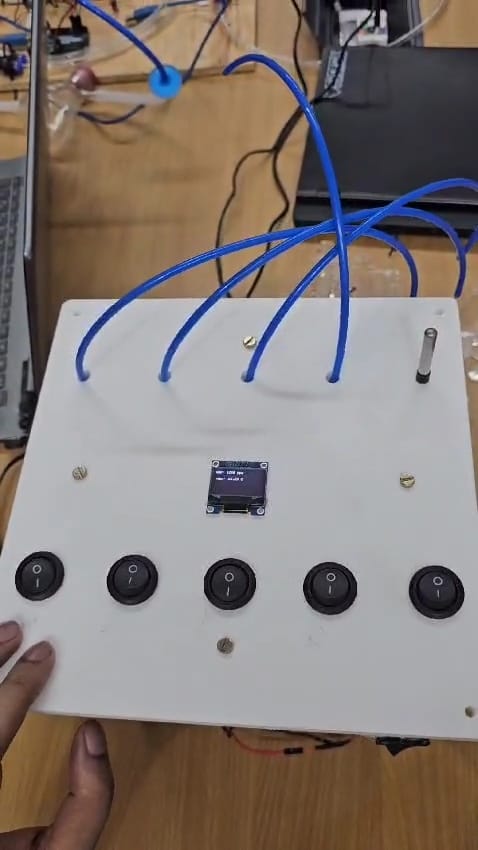
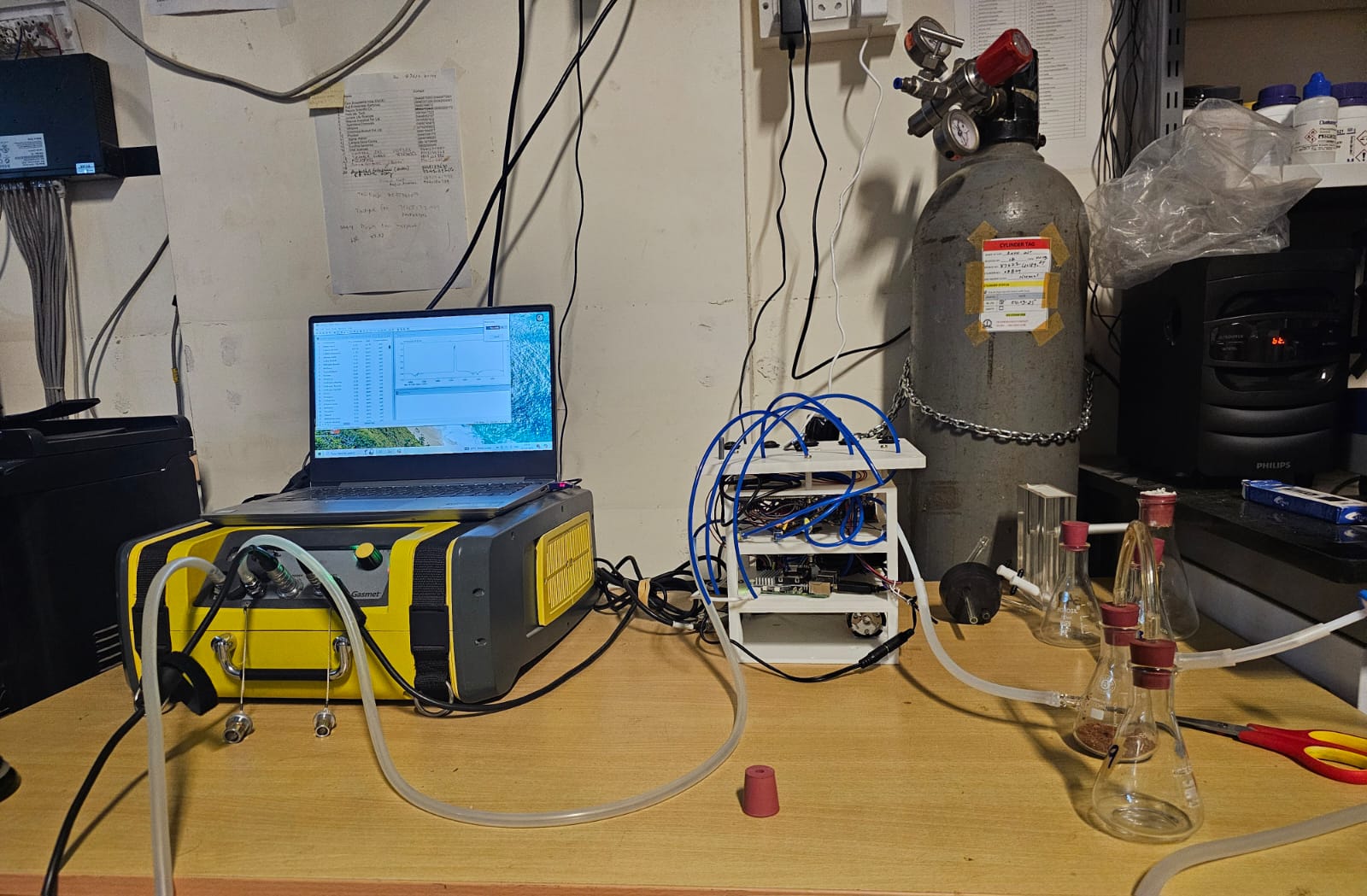
Instrument, top view.Gasmet FTIR + Terrapulse, closed-loop cross-calibration in lab.Terrapulse Mini · solar-powered revision (render).Mini enclosure · alternate angle.
iGEM · Halocleen · Pseudomonas putida for halocarbon
biodegradation
IISc iGEM 2022 project, Paris Jamboree Gold Medal,
Climate-track finalist. Two bioreactor designs with patents pending.
Problem. CFC-11 and CFC-12 persist in the stratosphere for decades
with no scalable biological degradation path. The project asked whether an
engineered soil bacterium could be coaxed into degrading halocarbons at rates
relevant to atmospheric removal.
Approach. Engineered Pseudomonas putida as the chassis,
carrying synthetic circuits assembled from plasmids drawn from the methanotroph
halocarbon-oxidation literature. Two bioreactor designs (continuous-flow
trickle-bed and gas-lift variants) were optimised for the low-solubility
substrate regime; patents filed, pending.
My contribution. Lead of the Hardware subteam
(bioreactors and initial biology research), 2022. Covered in the IISc press release:
IISc students win again at iGEM.
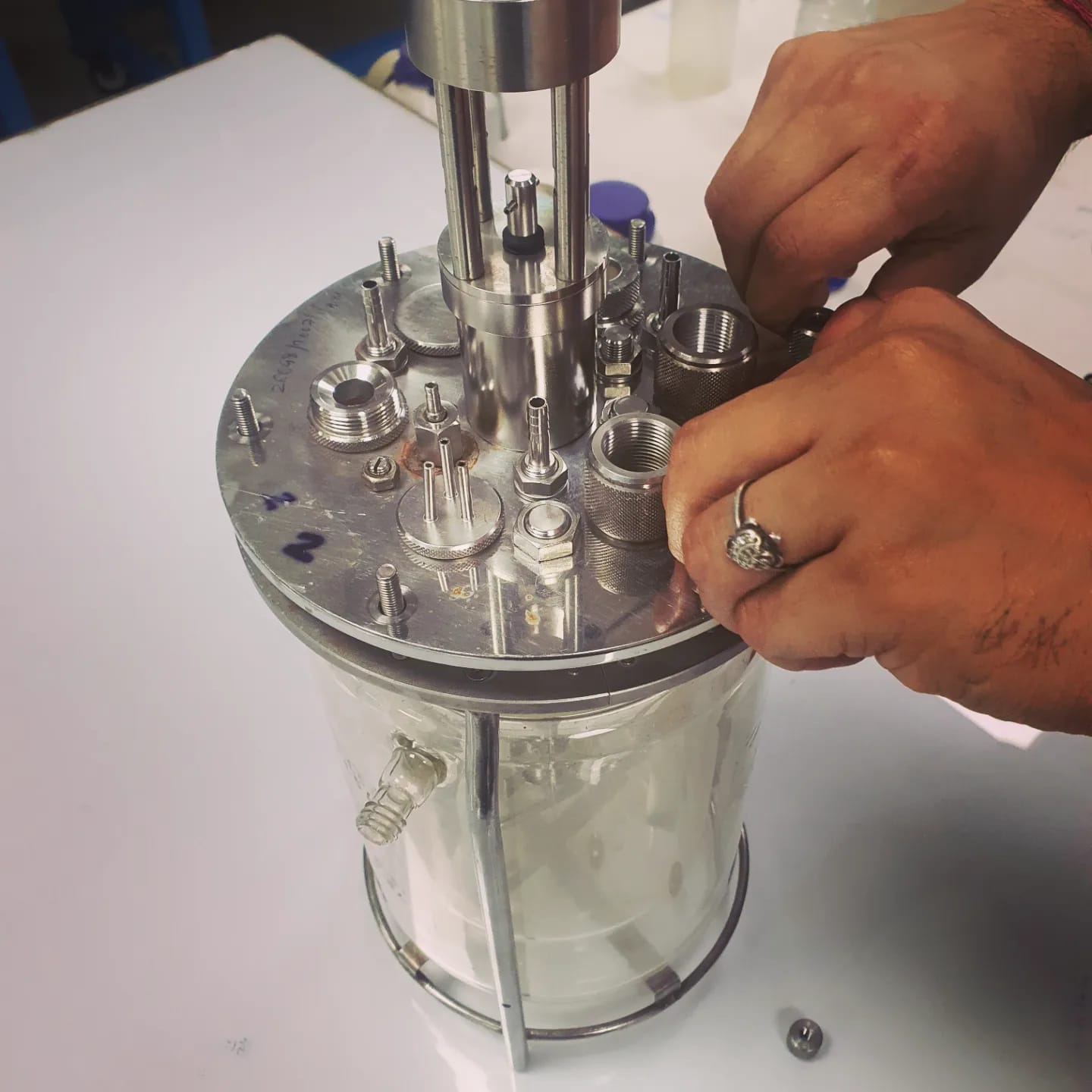
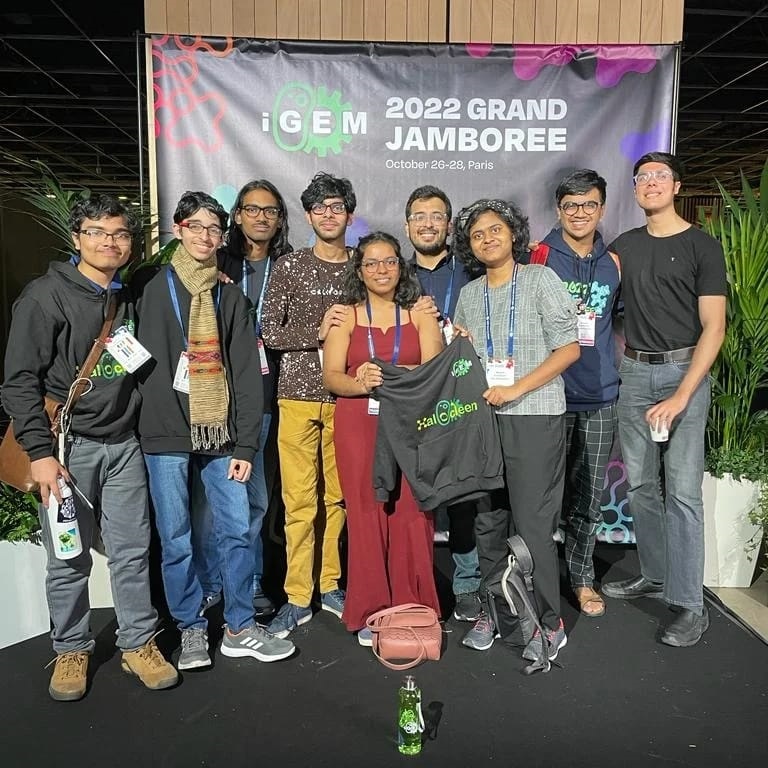
Bioreactor project after competition.iGEM 2022 Grand Jamboree, Paris.
A self-contained Lean4 kernel of formal learning theory, being upstreamed to
Lean4 cslib and mathlib. Four results it carries
that the field had been citing rather than proving:
Borel–analytic separation theorem: weakens the
Borel-measurability hypothesis of Krapp–Wirth 2024 to
analytic / null-measurable, with a strict separation witness (a concept class
whose bad event is null-measurable but not Borel). Closure under patching,
interpolation, and amalgamation. All main results formalised in Lean4.
Constructive MWU-based compression proof.
PAC-Bayes bound: first Lean4 formalization of record.
Choquet capacitability: previously absent from Mathlib4.
Formalization is the claim, checked by the Lean4 compiler.
The fundamental theorem, stated and
proved in the kernel as a single term
(FLT_Proofs/Theorem/PAC.lean):
PAC-learnability ↔ finite VC dim ↔ bounded compression
scheme ↔ vanishing Rademacher complexity ↔ polynomial growth function.
Sauer–Shelah, symmetrisation, and concentration inequalities are the three
loadbearing lemmas.
Transformer Learning Theory
Measurability-theoretic foundations for attention architectures.
Lean4 results: attention-routing measurability; softmax–argmax equivalence under
appropriate limits; a universality statement (every measurable router
is attention); and a NullMeasurable necessity result.
31 machine-checked theorems extending Spekkens's epistemic
toy-theory of quantum states.
A Lean4 formalization of Spekkens's 2007 epistemic toy-theory of quantum states,
together with HC(κ): the first continuous measure of
interpolation failure in epistemic theories of mechanics. HC = 0 iff the
theory's admissible configurations are rectangular (decomposable).
Boundary results. The four entangled states admit HC = 2.00 bits;
the three separable states admit HC = 0. Only private-evidence
conditioning collapses nonzero HC; shared evidence resolves 0% of it. A
cross-domain oscillation theorem the Lean4 kernel checks by construction. Three
predictions beyond Spekkens follow as corollaries and are verified in the kernel.
LLM harness · First Proof Challenge
Synthetic Discovery
An LLM-driven proof search harness that reached 4 of 10 on Harvard's
First Proof Challenge benchmark using $32 of commodity API compute
on a single MacBook. The number is not the point. The shape of the failures is.
Where the harness succeeds is where formalization gates exist; where it fails is
where they are absent.
Neuroscience Modeling
Hyper-Resonant Dendritic Oscillations (HDO)
Single-neuron timing primitive · preprint on request.
Claim. A single stellate cell carries two stable intrinsic
oscillatory regimes (a θ-like slow regime and a high-frequency HDO regime)
with stochastic switching driven by channel noise.
Mechanism. Stochastic CaV gating (Gillespie) plus a
calcium-activated current plus BCM-like intrinsic plasticity regulates the
transition probability between regimes. Bifurcation reasoning points to a
subcritical Hopf / SNIC candidate; robustness confirmed under parameter sweeps.
Consequence. A timing primitive that is neither a fixed oscillator
nor a pure integrator. The metaplasticity-gated switching between regimes is
itself the computation.
Origin: a final-project artifact of Prof. SP Arun's Theoretical and Computational
Neuroscience course at IISc.
Open Python platform for machine-checked neurobiophysics.
Converts ModelDB .hoc models into a type-inheritance DAG so
neurobiophysics models can be composed, type-checked, and verified like programs
rather than passed around as opaque simulation scripts.
NIAS collaboration · Neurochaos learning for calibration
With the National Institute of Advanced Studies, IISc campus.
Using neurochaos-learning primitives (chaotic-attractor features) as a calibration
substrate for biosensors where conventional linear calibration is brittle to
nonstationary confounders.
Studying Discovery While Doing It
Each of the programmes below was run as a nested experiment: a social and
research test of what makes discovery faster, more reliable, and less accidental at a
given scale. The order is ascending: founder / student-club to team, team to
chapter, chapter to programme, programme to research institute.
Virog MedTech
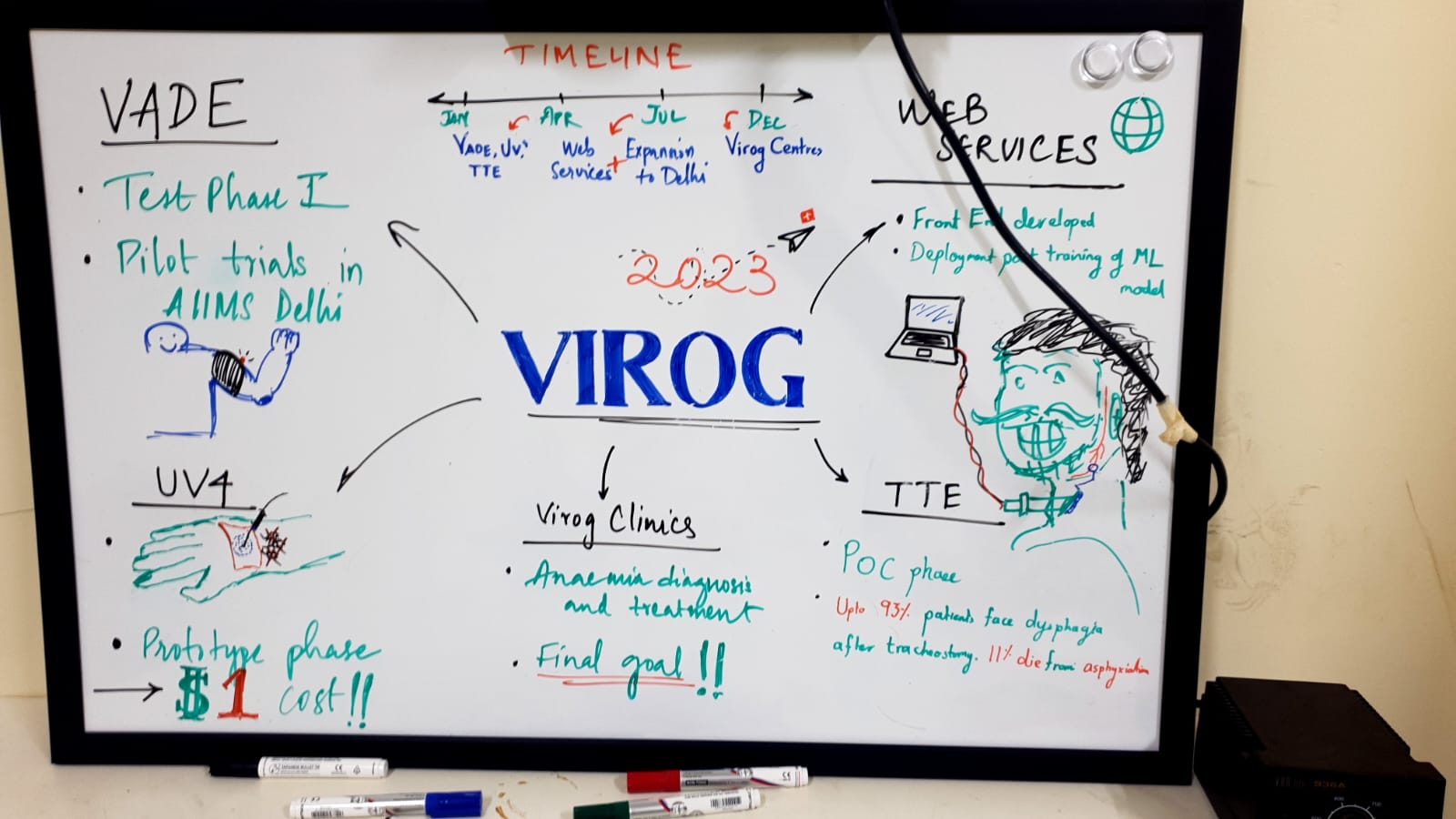
Founder · IISc-funded student medtech club. ~5 people.
Institutional grant pool of ₹10 L.
What was tested. Whether a five-person student team, with an
institutional grant pool but no commercial pressure, could deliver three
independent medtech devices from first principles on pre-clinical timelines.
Devices. OECT wound bandage; UV-SSI patch for HAI prevention;
physics-driven CVD predictor.
Highlight. The CVD predictor won
1st prize at IIC 2025 (IISc Innovation Challenge).
The club is now inactive;
the three devices and the mentorship chains came out of it, and the structure of
the experiment is what we kept.
Founder & President, 2022–2023. ~30 members.
₹5 L club budget.
What was tested. Whether parallel multi-domain student robotics
projects can run concurrently under a shared budget without losing depth.
Active lines under the club: lunar rover, rehab exoskeleton, drone, 6-DoF
manipulator, legged-locomotion prototypes.
Team Vicharaka · University Rover
Challenge. Outside this club, the Mars-rover team
Vicharaka ("one who thinks") qualified for the
University Rover Challenge (URC)
at the Mars Desert Research Station, Utah. I led the
Life-Detection subsystem: biosignature-sampling and onboard
assay for the Martian-soil analogue, pipelined to the rover's onboard compute.
Coverage by IISc's
Connect IISc: “Red Rover”.
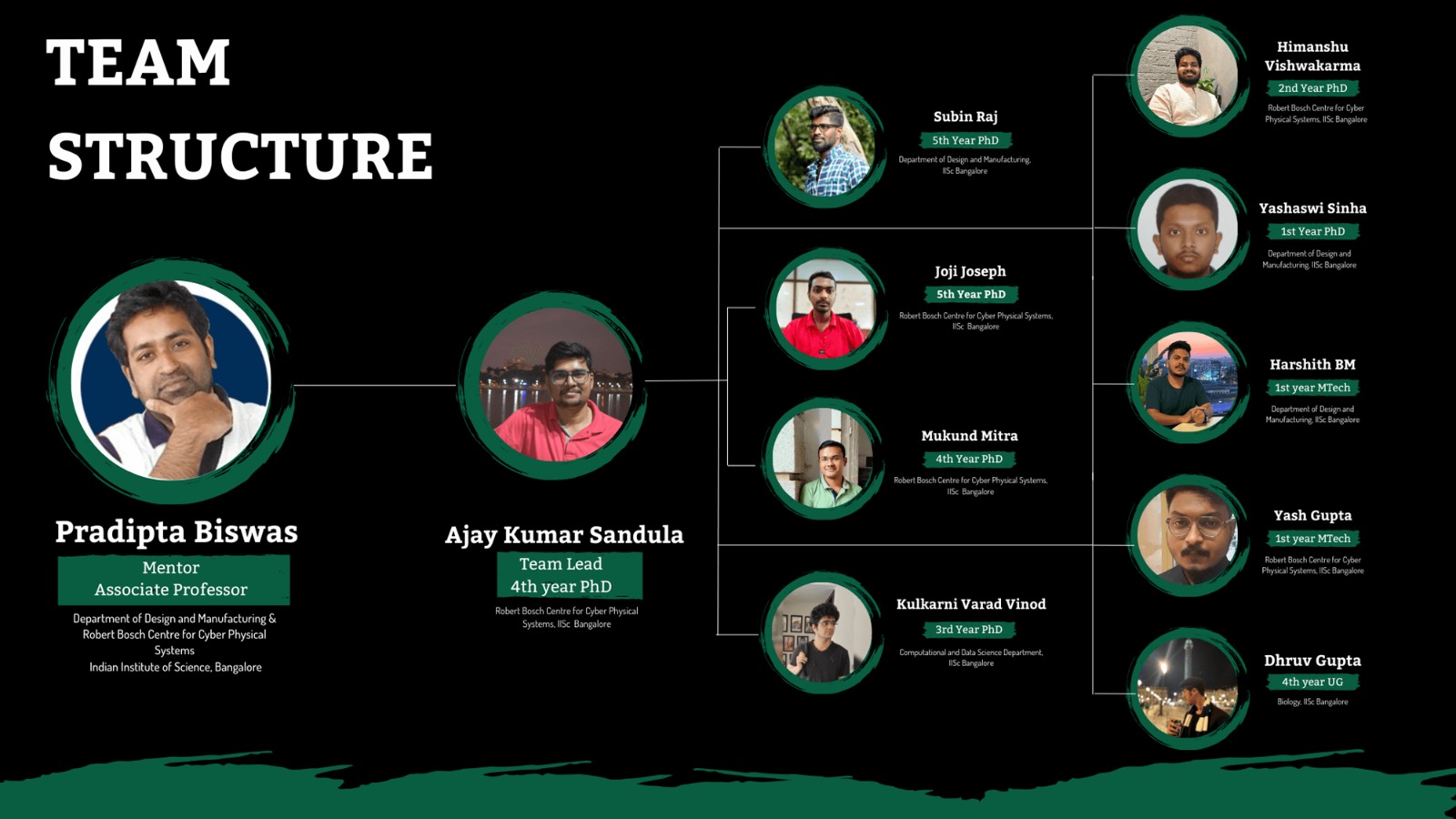
Prof. Pradipta Biswas's lab team ·
ISRO IRoC-U 2024 finalist. A separate rover team, based in
Prof. Biswas's group at the Nahar Centre for Robotics · Robert Bosch
Centre for Cyber-Physical Systems, IISc. The team was a finalist in the
ISRO Robotics Challenge (IRoC-U 2024) run by
URSC, securing a ₹25 L grant. I was the undergraduate team member
contributing the biology half of the lunar-surface assay stack.
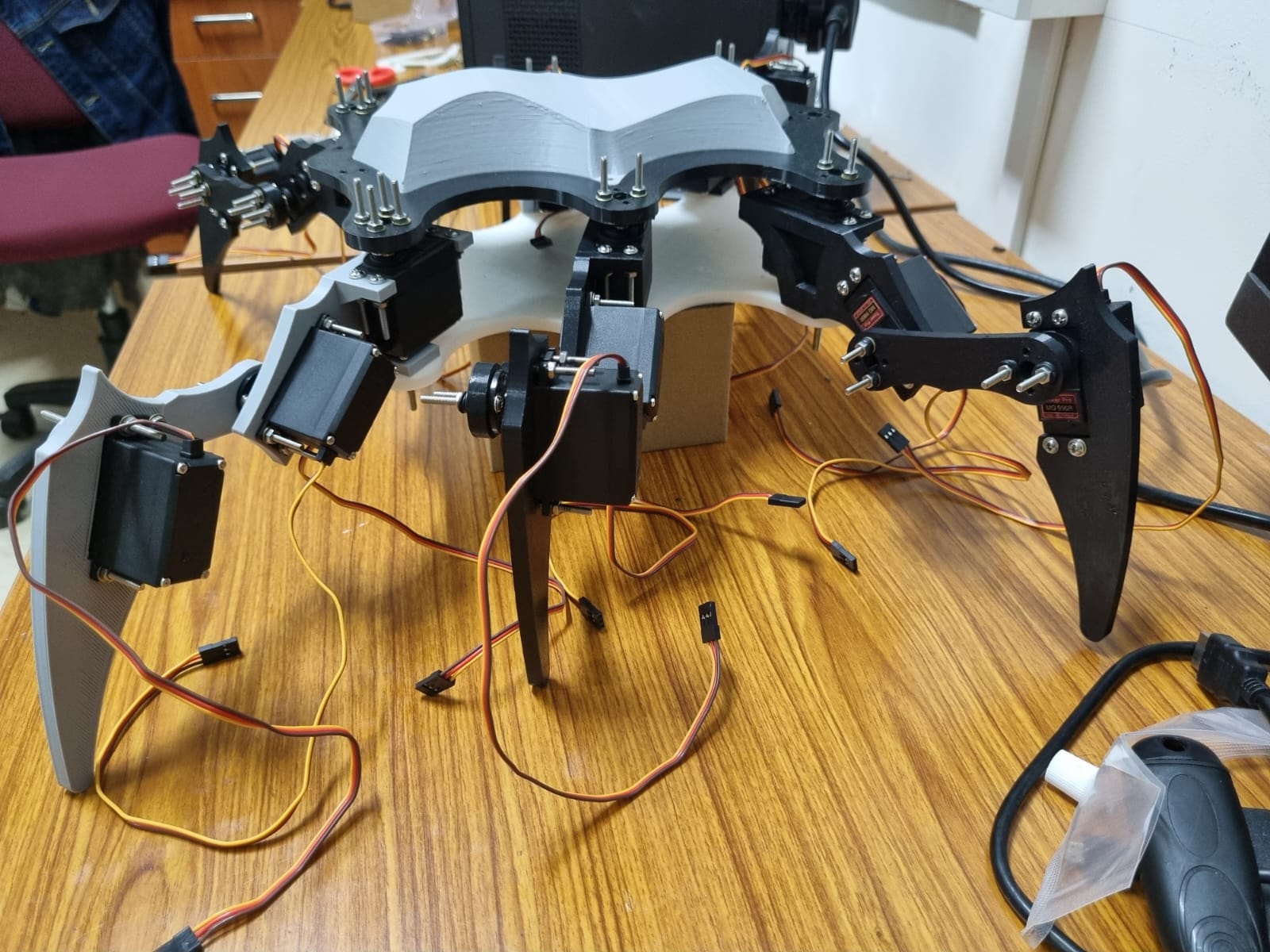
Club prototype: 18-servo hexapod.Biswas lab IRoC-U team · click to enlarge.
EntIISc · IISc Entrepreneurship Cell
Vice-President. 44 deep-tech proposals screened. Brokered
₹15 L seed pool (FSID).
What was tested. Whether a campus cell, working inside the IISc
incubation structure, could route deep-tech student proposals to institutional
funding at scale. Output: 44 screened proposals, Boeing sponsorship, and a
working pathway to the FSID institutional grant pool.
External validation.
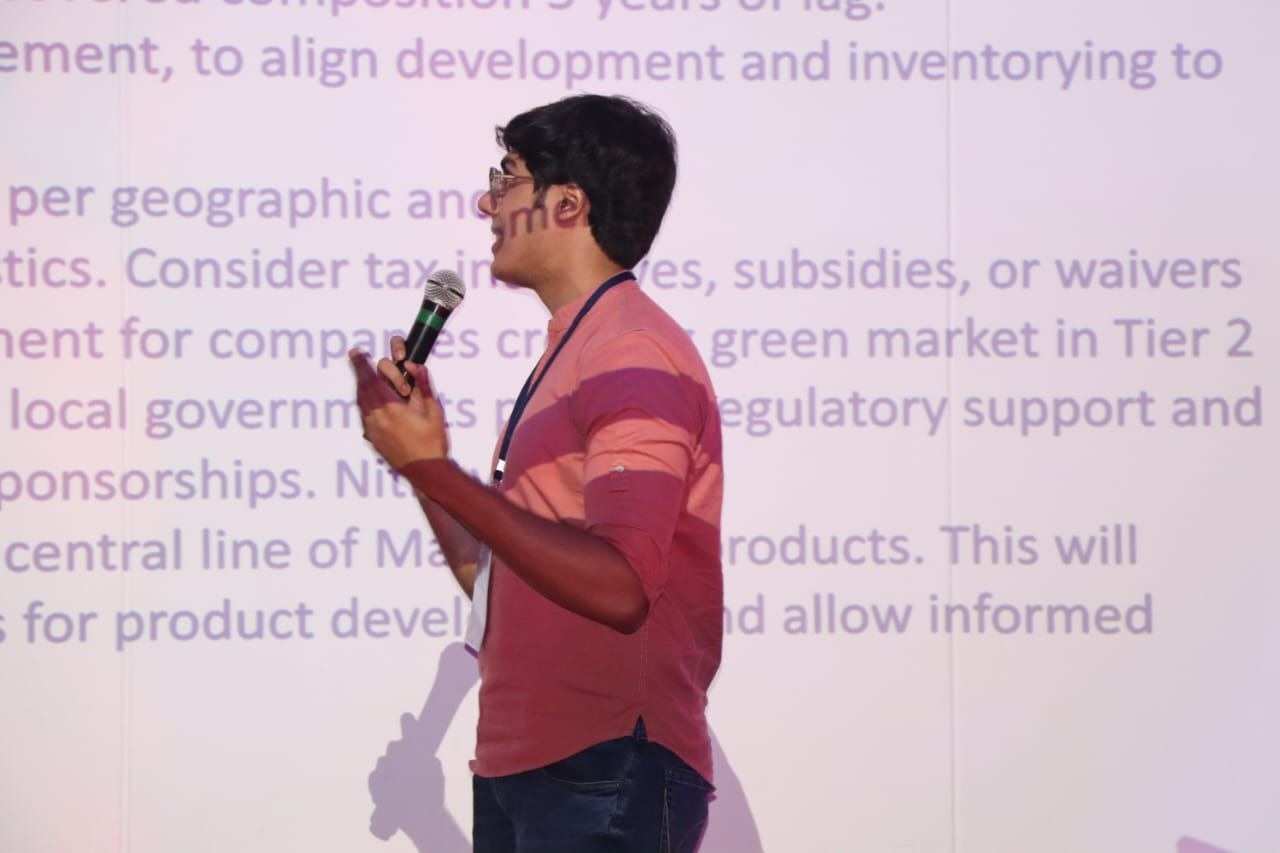
EntIISc won first place at E-merge, the inter-institution
entrepreneurship-cell competition run by IIT Hyderabad's E-Cell. I pitched on
behalf of the cell and served on the event's panel alongside other cell leads
and invited speakers.
What was tested. Whether the chapter could broker a concrete
undergraduate-to-graduate research-exposure loop at low institutional friction, alongside
running an open curriculum under the IEEE brand.
“Hire an Undergrad” programme.
The main operational artifact of my term. MTech and PhD students could post short
project briefs on the chapter board and, with their supervising professor's approval,
“hire” an undergraduate as a research assistant for a scoped piece of
the project. Undergrads got first-contact research exposure on active problems
(not make-work); grad students got a documented assistant pool without rewriting
bureaucracy. The matching itself was lightweight: a one-page brief, a faculty sign-off
line, a handshake.
Other outputs. Open-source 6G lecture
series.
IEEE CS/CIS Student Chapter, IISc · event with faculty advisors.
What was tested. Can the same operator catch the
center-of-mass unknown in eight unrelated domains within a single summer?
All 8 tracks reached working prototype; the portfolio itself is the contribution.
Voice-first teleoperation of a robotic arm from smartphone
(safety + latency trade-off).
Digital-twin-driven bionic arm with calibration drift as the
primary failure mode.
Low-cost servo + encoder stack (FSM decoding of noisy
inputs).
BCI/EEG → text with generative-AI coherence gates.
Physics-to-math knowledge engine (compiler as verification
gate).
General-purpose multi-I/O power converter.
Fuel-quality automation with Pass/Fail/Inconclusive as a
first-class output.
Forensic triage with Bayesian uncertainty and mandatory
justification chains.
Also prototyped SoTA
instrumentation for the Karnataka Forensics Lab.
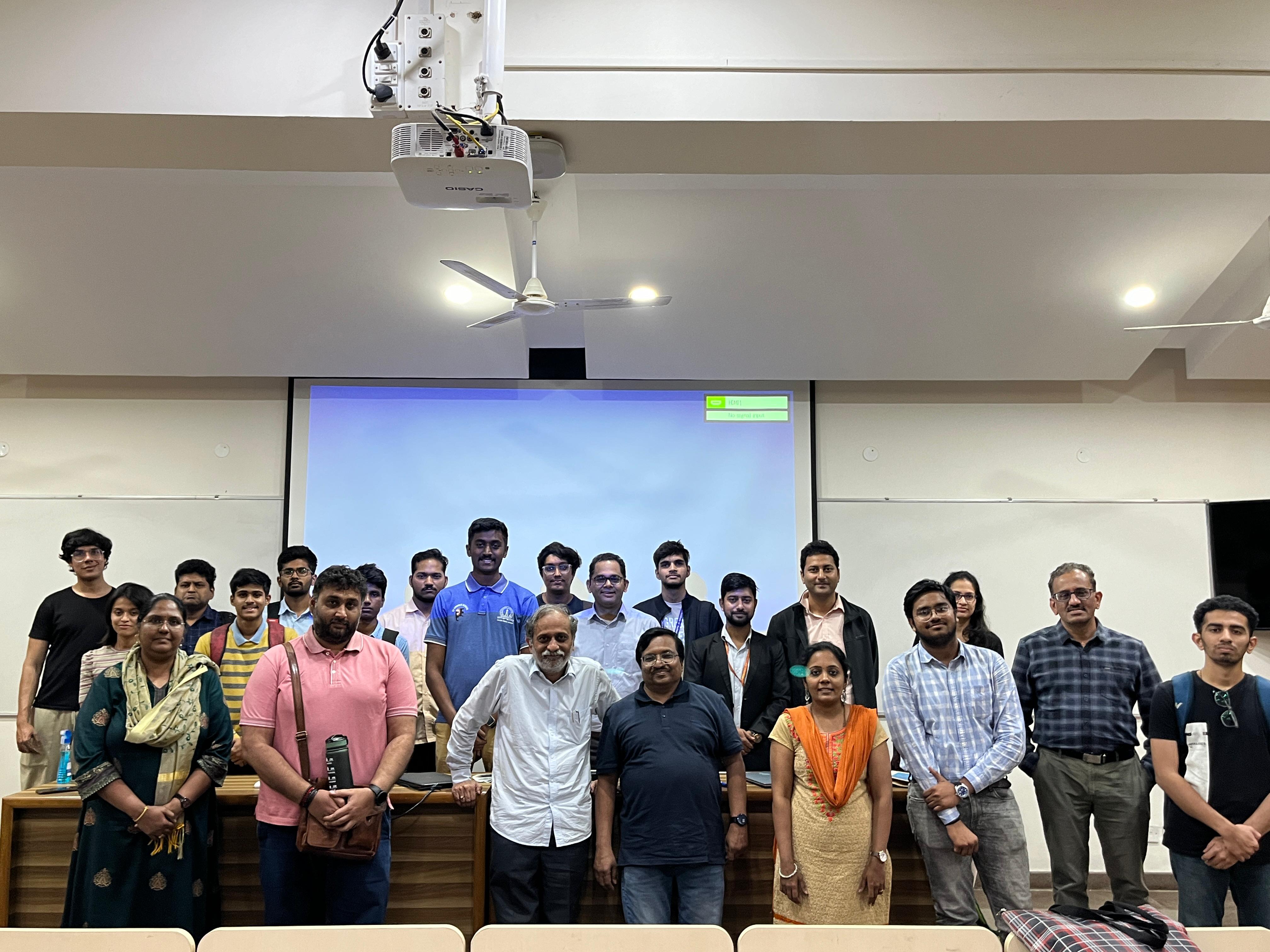
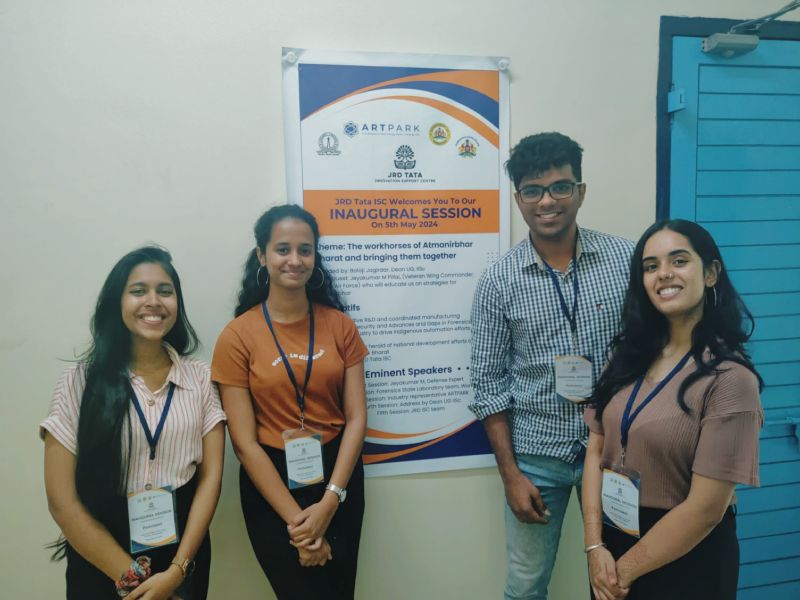
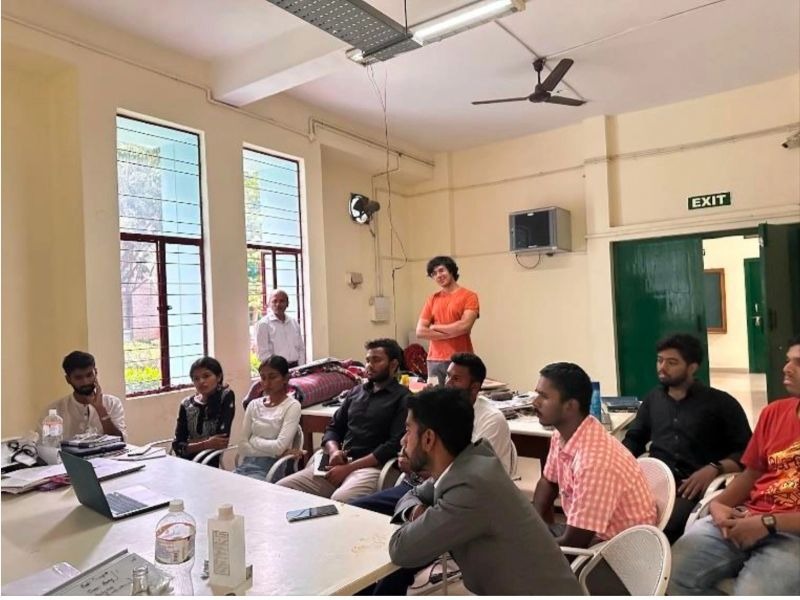
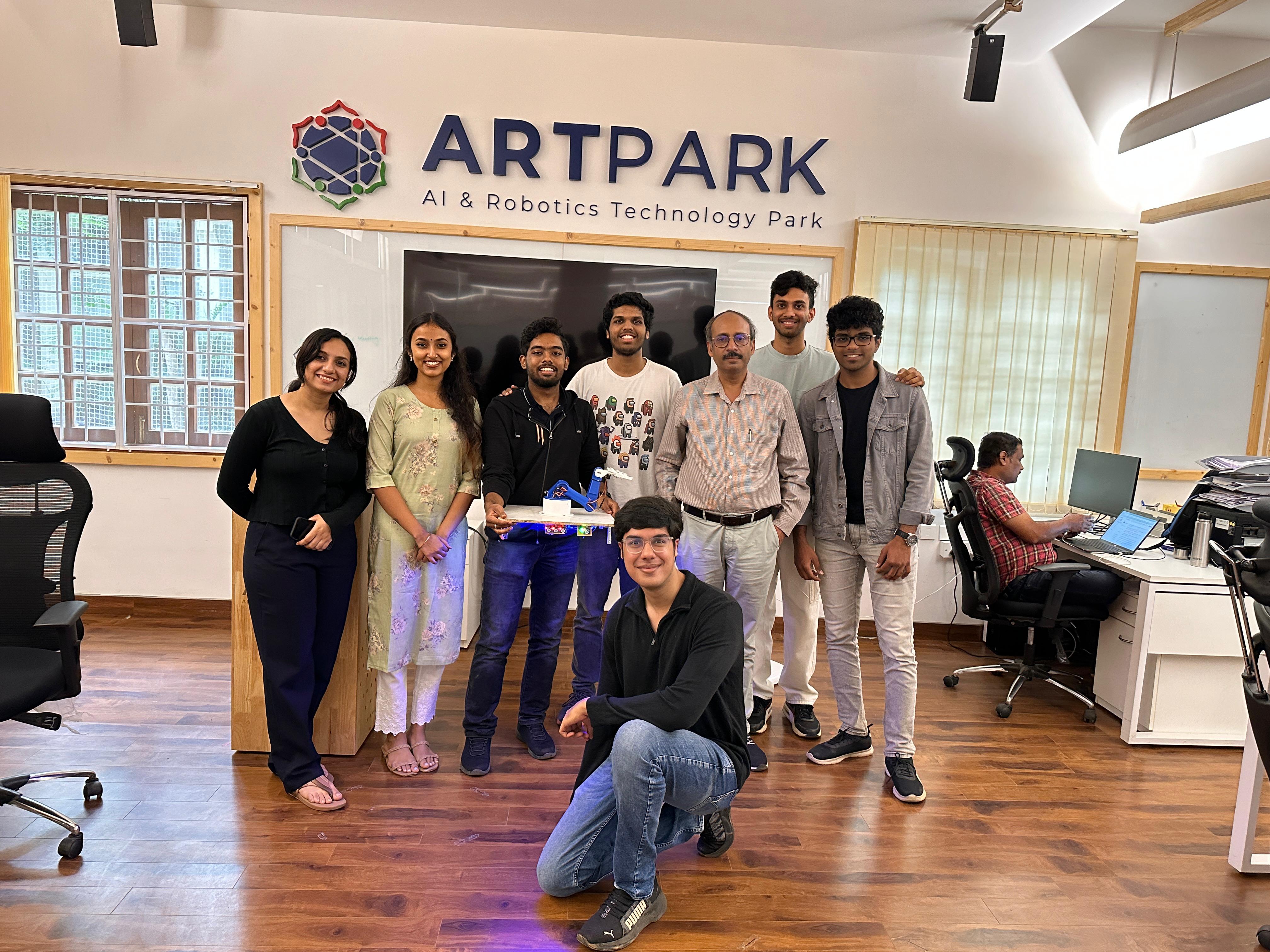
Inaugural session, 5 May 2024.Briefing the 40+-student cohort.Summer team at ARTPARK.
ARCNet · R&D venture program at ARTPARK @ IISc
Capital allocator and Research Core architect,
2024–Jun 2025. A $100,000 ARTPARK venture program in Physical AI.
The program. For a year I ran a $100,000 venture fund inside
ARTPARK: I picked five student-led teams in Physical AI, put ARTPARK's capital
behind them, and built the shared Research Core they worked on top of. Most won
outside client work; one became a company of its own. I decided where the money
went and built the technical spine; the teams took it from there. Their client
work is below.
Satsure · KALIDEO
Remote-sensing QC · classical +
deep-learning
Dockerized pipeline testing classical and
deep-learning approaches for cloud segmentation on satellite hardware.
Optimized for on-device inference under bandwidth and power
constraints.
Automated grading of interviews, presentations,
and speech, with LMS integration. Audio capture, video capture,
grading pipeline, LLM feedback, and report generation run as
independent microservices so each can be scaled, swapped, or audited
without touching the others.
OSS is a volunteer-driven, non-profit digital public
infrastructure for AI-powered, self-driving labs, backed by ARTPARK
(IISc) and the Red Black Trust. Its architectural thesis: treat
experiments as cloud-dispatchable programs (“write once, run
anywhere”) across a network of programmable physical labs.
The Science Compiler is my contribution: a three-layer
behaviour-tree architecture for robotic laboratories that compiles
high-level scientific intent into robot-agnostic execution via
ontology-driven protocol synthesis. It slots into OSS's inner
experiment-optimization loop and feeds the ROS2-based Robotic
Application Stack (RAS).
ARCNet contributed to LeanAide, a Lean4 assistant for
natural-language mathematics, at Prof. Siddhartha Gadgil's lab at IISc.
It tackles autoformalization (natural-language math into
machine-checkable Lean4), one of the least-developed bridges between
LLMs and formal verification.
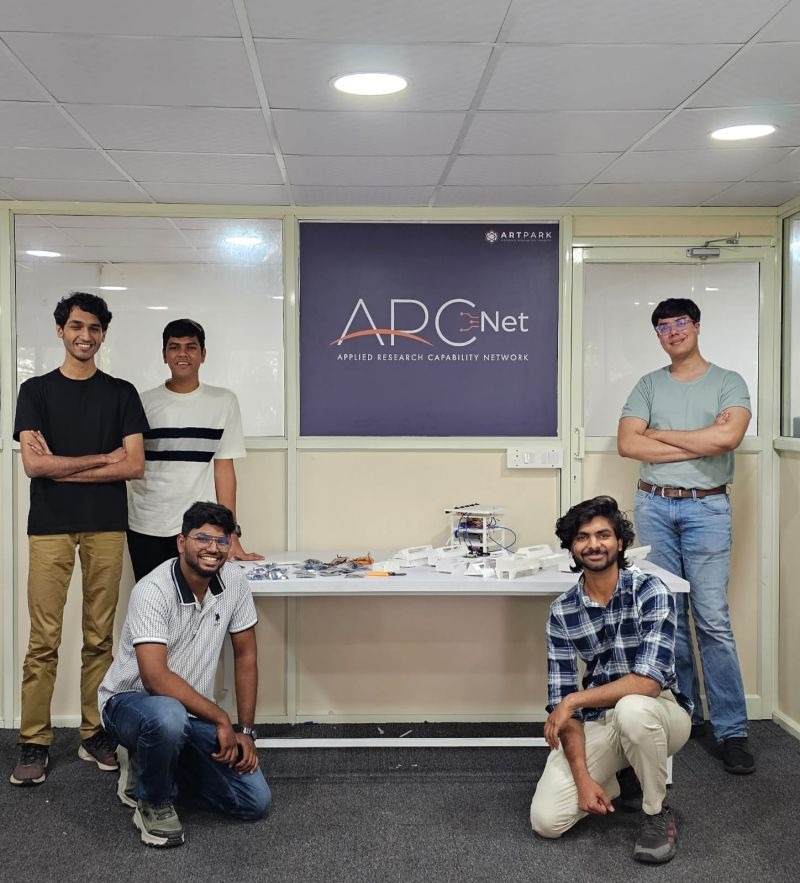
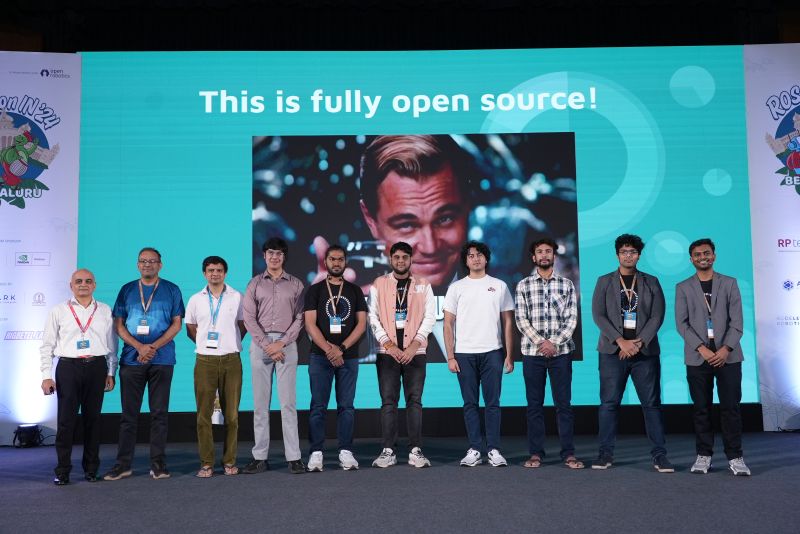
CO2mmunity project team · ARCNet engagement at ARTPARK, IISc.OSS on stage at ROSCon India.
ARTPARK Industry 5.0 · Innovator-in-Residence
Innovator-in-Residence · Board Member,
2025–2026.
What it was. Innovator-in-Residence with a seat on the
Industry 5.0 board, running manufacturing R&D automation pilots with BEL,
Bosch, and Toyota. The brief: take the lab's formal-epistemology work and make
it survive contact with a real factory floor.
Noumenal AI · Principal Scientist
Full-time, 2026–Present. Bengaluru.
Building Pearl's causality up from the foundations in Lean4, toward a
consolidated causal learning theory we mean to open-source. And a new way to
publish machine-learning and statistics research: mechanized review held to the
strictest standard, with an AI scientist that keeps the field's knowledge
current.
ARTPARK @ IISc · Senior Researcher
Part-time, 2026–Present. Hybrid.
Autodidactic intelligence: AI that intervenes on its own data to learn the
mechanisms behind what it sees, and works on itself to find better
representations of them.
Course Projects
Cool projects from coursework.
Creative Engineering Design · Classroom Chair
PD 203, Prof. Amaresh Chakrabarti, CPDM / IISc, 2024. Group
project.
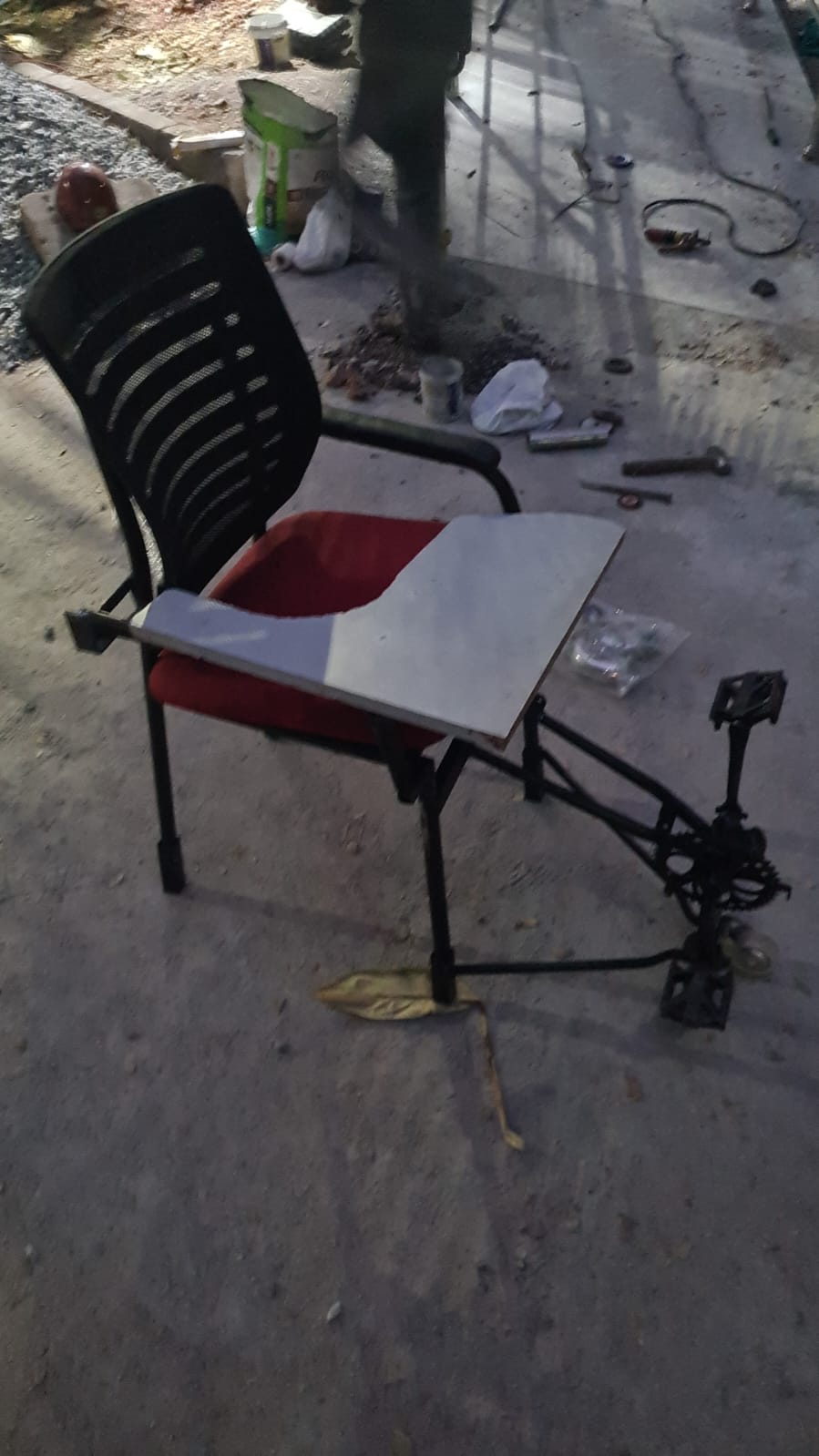
A classroom chair with a steering tripod (so it can be lifted and wheeled for easy
cleaning) and a floor-pedal coupled to a dynamo that trickle-charges a phone once
the rider is pedaling stably. The problem we chose to solve was classroom sleepiness,
a very real pandemic.
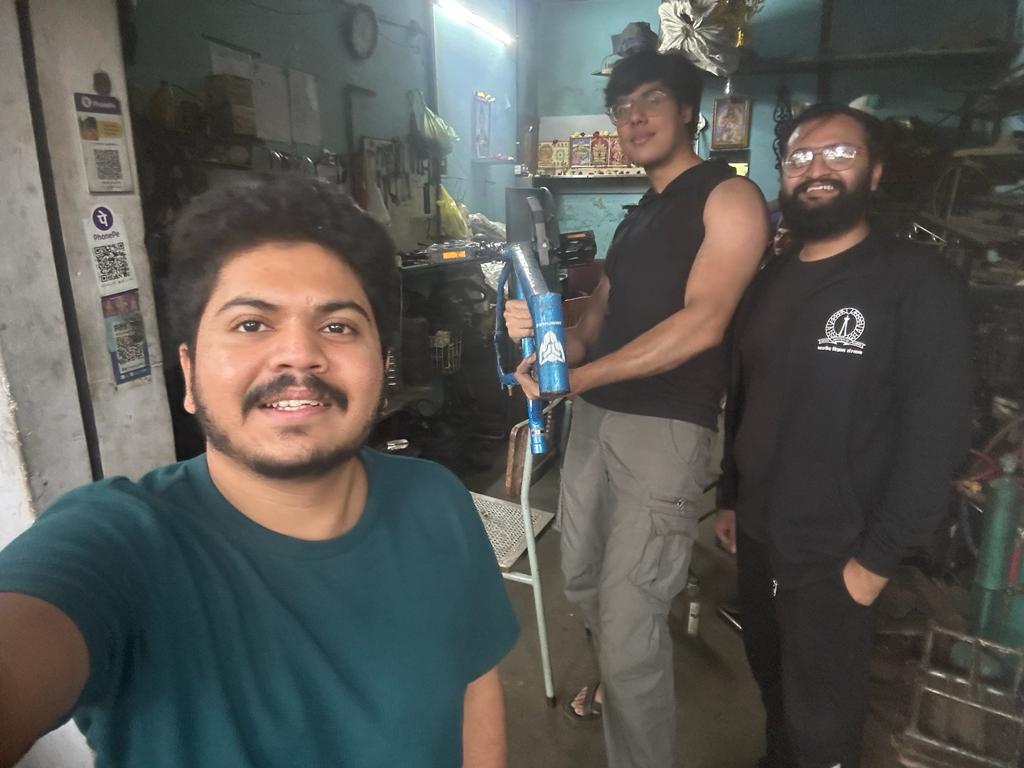
Team at the fabrication workshop.The finished chair · pedal, dynamo, clipboard, tripod.
Neuromorphic Analog VLSI Design · Binary Encoder Bit Correction
Final project: bit-correction in a binary encoder via a neuromorphic construct.
Alongside, during the course: a neuromorphic mod of SPICE, built as a local
substitute because Cadence access was gated to department MTech and PhD students
only.
Information–energy efficiency operator
MB 208 Theoretical and Computational Neuroscience, Prof. SP Arun,
IISc.
A complex-valued operator that expresses the energy–information tradeoff in
neural computation, studied in Brian2 simulations of a two-cell post-inhibitory
rebound oscillator.
-- Complex efficiency phasorΛ=|Λ|·e^(jθ)∈ℂ-- Phase-lag taxonomy θ-band Regime Functional role
──────────────── ────────────────── ─────────────────────────────
0°≤θ<30° reactive immediate transduction
30°≤θ<45° memory-forming partial integration
θ≥45°memory onset past input dominates
60°≤θ<75° planner/anticipatory predictive buffering
θ≥75° generative planner information allocates energy
Partial validation. Baseline and temperature-drift Λ posteriors
recovered in Experiments 1–2; the MPMOSS falsification sweep (Experiment 3) was
not completed. Mixed results; the taxonomy is a design proposal, not a validated claim.
More Projects
Expand (9 projects)
Clientless research
Artificial Neuroscientist
Clientless research · ARCNet-funded, same model as
Terrapulse.
Closed-loop spike-sorting and video-based behavioural grading wired to an
automated hypothesis → proof pipeline. Studies what a minimum-viable
neuroscience pipeline looks like when human-in-the-loop is optional and the
protocol is ontology-driven.
A cerebral-blood-flow physics world-model feeding an SPG-based wearable sensor;
brain phantoms for controlled validation; and a transfer-learning bridge from
SPG to PPG so the physics stays tethered to the sensor that survives reality.
Deterministic hemodynamics via radiometric inference
Physics-first pipeline for cuffless
hemodynamics: stiffness discrimination under controlled perturbations, treated
as an inverse problem against a tractable forward model rather than a regression
on raw PPG.
Multigas sensor suite · CO2 /
N2O / CH4
Sibling programme to Terrapulse extending
low-cost field chemistry to three greenhouse gases. KOH / V2+-HCl /
KI colourimetric chemistries paired with NDIR and catalytic readouts; LoD
< 10 ppb across species.
Siemens knee-resection robot
6-DoF surgical manipulator with a physics-
accurate digital twin driving pre-cut trajectory planning; ±0.2 mm
bone-cut fidelity at proof-of-concept. Shared platform for kinematic
verification experiments.
Formal theory (secondary)
ICM Unbundling
Lean4 formalisation of OOD geometry for factored
knowledge-graph embeddings.
Seven theorems proving that independent causal mechanisms make distribution
shift geometrically visible, with VC-dimension bounds, a risk decomposition,
and an entanglement-vulnerability converse. The converse does the work:
entanglement is a vulnerability, not a feature.
FLT dataset + fine-tuned SLM
Structured JSON dataset for formal learning
theory paired with a fine-tuned small language model specialised in FLT
formalisation. Built to close the gap between high-effort human proofs and
machine-assisted formalisation. Repo:
formal-learning-theory-dataset.
Generate-and-verify pipeline for physics problems.
Compile/filter workflow producing 500+ labelled mechanics problems with
verified solutions. A concrete test of whether synthetic problem
generation can cross the quality threshold required for training data. The
answer was yes, when verification is load-bearing.
BCI/EEG → text with generative-AI post-editing (JRD)
Neural signal decoding with coherence-checked synthesis.
Decoding pipeline from low-density EEG to natural-language text, with synthetic
data augmentation and a coherence-checked LLM post-edit stage. Exploratory
decoding metrics; the useful result was the post-edit gate: without it, fluent
hallucination dominates.
Neuroscience (secondary)
Contact
The most useful opening is a paragraph describing the problem,
the constraints, and what solved would look like. I read everything
directly.
Knowledge is what remains after inquiry. Ignorance is not a residual error term; it has
internal geometry. If you can represent that geometry, you can engineer discovery.
The conventional view treats ignorance as noise, a residual to be minimized by
more data or better models. That view predicts monotonic progress with compute. What
we observe instead is that the hardest problems keep the same shape as compute grows:
more of the same model on more of the same data converges to a better version of the
same failure.
Zetema's reversal is the starting move. If ignorance has internal structure, progress
depends on acting on that structure, not dissolving it. The rest of this page
shows what the programme has produced. This section describes the framework
that produced it. It is not decoration; it is the operating manual for every artifact
above. The sections below are intentionally sparser than the work above; each
is load-bearing, and none are duplicated.
Hover a node to read its definition.
Calculus of Discovery
Internally I represent a local theory-state as a compact object
URS = ⟨A, M, R, T⟩: axioms, mechanisms,
representations, traces. Inquiry is a small set of primitive operators that modify this
object. Each corresponds to a concrete capability of a deployed system.
Imagine (abd)
Propose new variables or mechanisms. Migrate unarticulated
regularities into explicit questions. This is where grammar grows.
Quadrant transition: UK → KU.
Experiment (do)
Design minimum interventions that collapse uncertainty cheapest.
The cost function is real, not metaphorical.
Quadrant transition: KU → KK.
Describe
(rep)
Retype traces into stable representations. Keep language
consistent with what data can actually carry.
Quadrant transition: stabilize KK against drift.
Communicate
(com)
Import external knowledge as traces or representations, not
axioms. Other people's certainty does not become yours automatically.
Quadrant transition: URSi ↔ URSj,
via shared traces.
Measurement classes
A single "confidence" number is a projection; like any projection, it drops
information. Zetema tracks four orthogonal measurements instead. They do not aggregate:
a claim can be high-Pl and low-Coh (admissible, but doesn't compose), or high-Comp and
low-Inv (everything is resolved inside a frame that dies under perturbation). The four
are the minimum set that doesn't lose structure.
Class
Operational question
Plausibility (Pl)
Could this claim be consistent with current structure? Is it admissible
at all?
Coherence (Coh)
Does the claim compose with other admitted content, or does it fracture?
Invariance (Inv)
Does it survive perturbations of the current frame, i.e. coherent future
challenges, not just repeated trials?
Completeness (Comp)
What fraction of the obligations the claim induces are actually
discharged?
Efficiency of validated novelty:
η = ΔKvalidated ∕ (E × Iprior)
Low η typically signals missing causality, missing abstraction, or missing
intervention design rather than low effort; it reads as a diagnostic of where
the work is missing.
Cognitive architecture: learning vs imagination
Two agents with the same traces can diverge because they factor the world differently.
That factoring is a property of the agent, not the data. Zetema names two distinct
faculties rather than compressing them into "intelligence":
Learning
Supplies bedrock content. Tends to constrain you to what is
repeatedly experienced and safely generalized. Learning admits
constraints.
Imagination
Posits a structure cheaply from thin traces, then acts to make
it real through tools, experiments, and world-shaping. Imagination
expands agency.
A serious system keeps ignorance explicit while still allowing fast synthesis.
Learning without imagination is corrigible but timid; imagination without learning is
bold and wrong. Modern LLMs, absent verification gates, are the second case made
concrete: fluent imagination with no admitted constraint. The measurement classes
above tell you when the second case has occurred.
Formal verification as infrastructure
Formalism here is not decoration. It is the substrate that makes reasoning systems
converge, makes ignorance explicit, and keeps explanations tethered to what can be
justified. Without it, the previous three sections reduce to vocabulary: a nice way
to talk about what discovery should feel like, with nothing checking whether the talk
matches the system.
Lean4 is the working language for three specific reasons. First, proof terms
are first-class evidence: a Lean proof is the object it
certifies, not a citation to one. Second, the type system makes
ignorance explicit: every hypothesis, every assumption, every hole appears as a type
obligation that cannot hide. Third, decidable type-checking with explicit universe
management scales: the 21,728-line FLT kernel stays sound because no part of
it relies on a human's mental model of what should have been proved.
The programme trades on this directly: every output that leaves a Zetesis
system can carry a checkable receipt. A partner does not have to trust the
reasoning; they can verify it.
Current tools: Lean4 / type theory / structured knowledge graphs. Research direction:
a geometric lens on model behaviour (including LLMs) where homogeneity, impurities,
and phase transitions in generalization are treated as objects rather than side
effects.
Everything above the divider is evidence. Everything below it is
the grammar that generated it. If the grammar is load-bearing, the
evidence ought to feel inevitable in retrospect: each pilot, each kernel,
each programme slotting into a place the framework had already named. That is
the claim, and the rest of the page is how we are checking it.